Why Dana Cannot Claim Bed Sheets, Towels & Cookware as Educational Expenses on Taxes
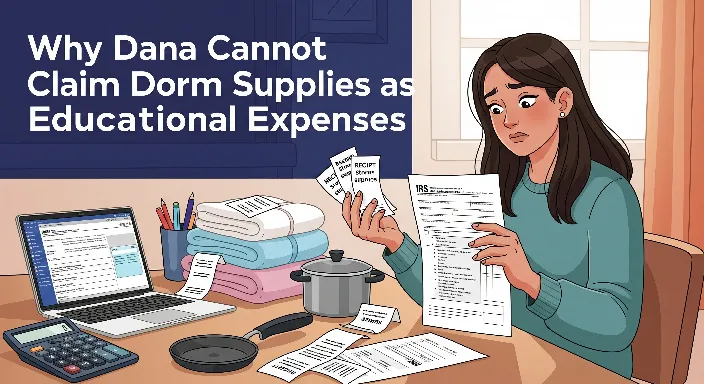
Dana is disappointed that she cannot claim her dorm room supplies—like bed sheets, towels and cookware—as part of her educational expenses. This guide explains, in plain English and with IRS-backed rules, the best reason those items don’t qualify, what *does* count, possible exceptions, and smarter ways to reduce college costs on your tax return.
Quick answer (for skimmers)
The best reason Dana cannot claim bed sheets, towels and cookware as educational expenses is that they are personal living items — not costs that are “required for enrollment or attendance” at an eligible educational institution for the tax credits most students use. In short: these are personal household expenses, not qualified education expenses under the IRS rules.
Why the question matters
College is expensive. When students (or their parents) learn they may be able to lower taxes with education credits or deductions, they understandably look for every eligible cost — including dorm supplies — to claim. Bed sheets, towels and cookware feel like part of the cost of attending college. But tax law — and IRS guidance — separates educational costs from personal living costs, and that distinction matters when you file. Getting it wrong can trigger an audit or a denied credit.
What the IRS calls “qualified education expenses”
To see why dorm supplies are excluded, we need to look at what the IRS accepts as qualified education expenses for popular tax benefits like the American Opportunity Tax Credit (AOTC) and Lifetime Learning Credit (LLC).
Publication 970 and related IRS pages make it clear that qualified education expenses generally include:
- Tuition and fees required for enrollment
- Academic books, supplies and equipment required for courses (sometimes)
- Course-related expenses that the school requires (e.g., specialized equipment or mandatory course materials)
- In limited cases, room and board — but only under specific rules and limits.
Notice what’s missing from that list: regular household goods like bed sheets, towels, plates, or small cookware. Those are treated as personal living expenses rather than costs required to attend class.
The single best reason — explained
Short version: Bed sheets, towels and cookware are personal living items and not required for enrollment or attendance, so they are not qualified education expenses for credits or deductions. This is the single, clearest reason Dana cannot claim them on her tax return.
Longer explanation: Tax credits like the AOTC exist to offset costs directly tied to pursuing a degree or taking courses — things the school requires, or that are necessary for the course itself. Personal items you buy to make dorm life comfortable do not meet the IRS test because:
- They are generally usable outside school (you can use sheets and pots for years, anywhere).
- Their purchase is not required by the school for enrollment or attendance.
- They are not listed as qualified course materials or equipment by the institution or the IRS rules.
Because of those three facts, the IRS classifies them as personal and nondeductible for the education credits/deductions that students most commonly try to claim.
What about “room and board” — doesn’t that cover dorm living costs?
This is where confusion often starts. Room and board can sometimes count as a qualified education expense — but it’s not the same as claiming dorm supplies like sheets or a frying pan.
Key points about room and board:
- For some tax benefits and accounts (for example, certain 529 plan withdrawals or when calculating the higher education tax credits in particular cases), a school’s published cost of attendance (COA) may include an allowance for room and board. If the student is enrolled at least half-time, some of that allowance may be treated as a qualified expense.
- Even when room and board is treated as a qualified cost, the IRS uses the school’s official allowance (or other limits) — not receipts for specific household items — and there are caps and rules. You can’t itemize individual dorm supplies as room and board on a tax credit simply because you bought them.
So yes — accommodation cost allowances can help — but no, that allowance does not turn individual personal goods into qualified education expenses.
Concrete examples to make it real
Common follow-up questions — answered
Q: Could Dana deduct the cost as a miscellaneous itemized deduction?
A: No — since the 2018 tax law changes, miscellaneous unreimbursed employee expenses and many other itemized personal deductions were suspended for most taxpayers through 2025. Even before those changes, personal household goods were not typically deductible unless used for business. So unless Dana has a legitimate business reason (see below), she can’t deduct sheets and pans as a miscellaneous deduction.
Q: What if Dana is self-employed and uses cookware for a paid on-campus food business?
A: If items are purchased and used exclusively to generate self-employment income (for example, a student-run meal service where cookware is directly used to prepare goods sold), then the cost may be deductible as a business expense on Schedule C — provided records substantiate the business use. Personal-use portions must be excluded. This is a business deduction, not an education expense. Keep receipts and document income/expenses carefully, and consult a tax pro.
Q: Can scholarships/fellowships be used to pay for sheets and other living costs tax-free?
A: Scholarship rules are particular: scholarship funds used for qualified education expenses (like tuition, required fees, course materials) are typically tax-free; amounts used for room and board may be taxable or nontaxable depending on the scholarship terms and qualified expense definitions. But the scholarship itself does not automatically convert personal purchases (like sheets) into qualified education expenses for the purpose of education credits. Different tax rules apply; review Publication 970 and scholarship terms.
When dorm-related costs can help on taxes (exceptions & alternatives)
Even though Dana’s sheets won’t count as qualified education expenses, there are a handful of related ways students and parents can get tax relief — none of which require listing every towel on a return:
- Room and board allowances (COA) for certain accounts: 529 plan distributions can cover room and board up to the institution’s allowance if the student is enrolled at least half-time. That’s an example where “housing” is recognized — but it’s an allowance, not a receipt-by-receipt deduction.
- Education credits for qualified tuition, fees and required course materials: Make sure Dana or her parents claim the American Opportunity Tax Credit (if eligible) for tuition and course-required items; this credit is one of the most valuable and often overlooked benefits. Check eligibility rules and income limits.
- Student loan interest deduction: If Dana (or a parent) pays student loan interest, it may be deductible up to limits — this reduces taxable income. This is separate from claiming supplies.
- Business deductions if supplies are used for income production: As noted, expenses used for a legitimate business (self-employment) can be deductible on Schedule C; personal vs. business use must be documented.
- State tax breaks: Some states have different rules for education-related deductions or credits. Always check state tax rules — state treatment may differ from federal. (State pages vary.)
How to handle this correctly on your tax return
- Know the difference: Classify purchases as personal living expenses vs. qualified education expenses.
- Use the right benefits: Apply for AOTC/LLC when eligible — these use tuition, fees and required course materials, not dorm supplies.
- Document carefully: Keep tuition bills, Form 1098-T (if issued), scholarship award letters, and receipts for business-used items. If you claim room and board via a 529, keep school COA details.
- Ask before you claim: Don’t attempt to claim dorm supplies as an education credit; the IRS sees them as personal. If you think there’s an unusual exception (e.g., the school explicitly requires a specific non-consumable tool for a course), confirm with a tax professional.
What Dana (and students like her) should do instead
If Dana is disappointed, she’s not without options. Here are practical, tax-smart steps:
- Prioritize qualified expenses: Make sure tuition, required fees and course materials are claimed properly. Those are the primary drivers of education credits.
- Use 529 plans wisely: If Dana’s family has a 529, use distributions for room and board (subject to COA and half-time rules) so those dollars remain tax-advantaged.
- Look for other credits/deductions: Student loan interest, education-related employer benefits, and certain state credits can help reduce tax burden even when dorm supplies can’t be claimed.
- Budget for dorm startup costs: Treat sheets, towels and cookware as moving-in costs — budget them, buy secondhand, share with roommates, or use minimalist starter kits to reduce outlay.
Checklist: How to evaluate whether something is a qualified education expense
- Was the item required by the school for enrollment or attendance?
- Is it a textbook, supply or equipment required for a specific course?
- Is the item durable and usable outside school (if so, more likely personal)?
- Does a specific tax provision (e.g., 529 rules) explicitly allow it under stated limits?
- Would claiming it under an education credit contradict school COA or IRS guidelines?
If the answer is “no” to the first two and “yes” to the third, it’s almost certainly a personal expense (like Dana’s linens and pans).
Useful official resources
If you want to read straight from the source, start here:
- IRS Publication 970, Tax Benefits for Education — detailed rules about what counts as qualified education expenses.
- IRS pages on qualified education expenses and credits — summary guidance and examples.
- Tax guidance sites (TaxAct, H&R Block, TurboTax) that explain common student questions and show practical examples.
FAQ — bottom line answers
Can I claim bed sheets, towels or cookware as educational expenses?
No. These are personal household items and are not qualified education expenses for the education credits most students use.
Can room and board sometimes count?
Yes, under limited circumstances (for example for 529 plan distributions or the school’s COA allowances if the student is half-time). But that doesn’t convert individual household purchases into tax-deductible education expenses.
What if my school forces me to buy a specific item for a course?
If the item is required for a course and the school clearly lists it as required course material, it may be a qualified expense (for example, specialized safety gear or a required lab kit). General dorm supplies rarely meet that test.
Conclusion — what Dana should tell herself (and other students)
Dana’s disappointment is understandable: dorm supplies feel like part of the true cost of going to college. But tax rules draw a strict line between personal living items and qualified education expenses. The best reason she cannot claim bed sheets, towels and cookware is simple and IRS-backed: they are personal household goods, not expenses required for enrollment or attendance. Knowing that, Dana should focus on capturing and claiming the expenses that the IRS recognizes (tuition, required course materials, possibly room-and-board allowances in limited cases) and use other tax-smart strategies — 529 plans, student loan interest deduction, careful budgeting — to reduce the financial pain of college life.
If Dana wants, she can also consult a tax professional to explore any unusual situations (business use of supplies, specialized required equipment, or state-specific rules).